
Automation · 2026
A line is not finished when it runs — it is finished when it runs at rate
Automation projects are costed around hardware and scheduled around installation. The risk sits somewhere else entirely: in the weeks between “it moves” and “it makes good parts at rate, on every shift.”
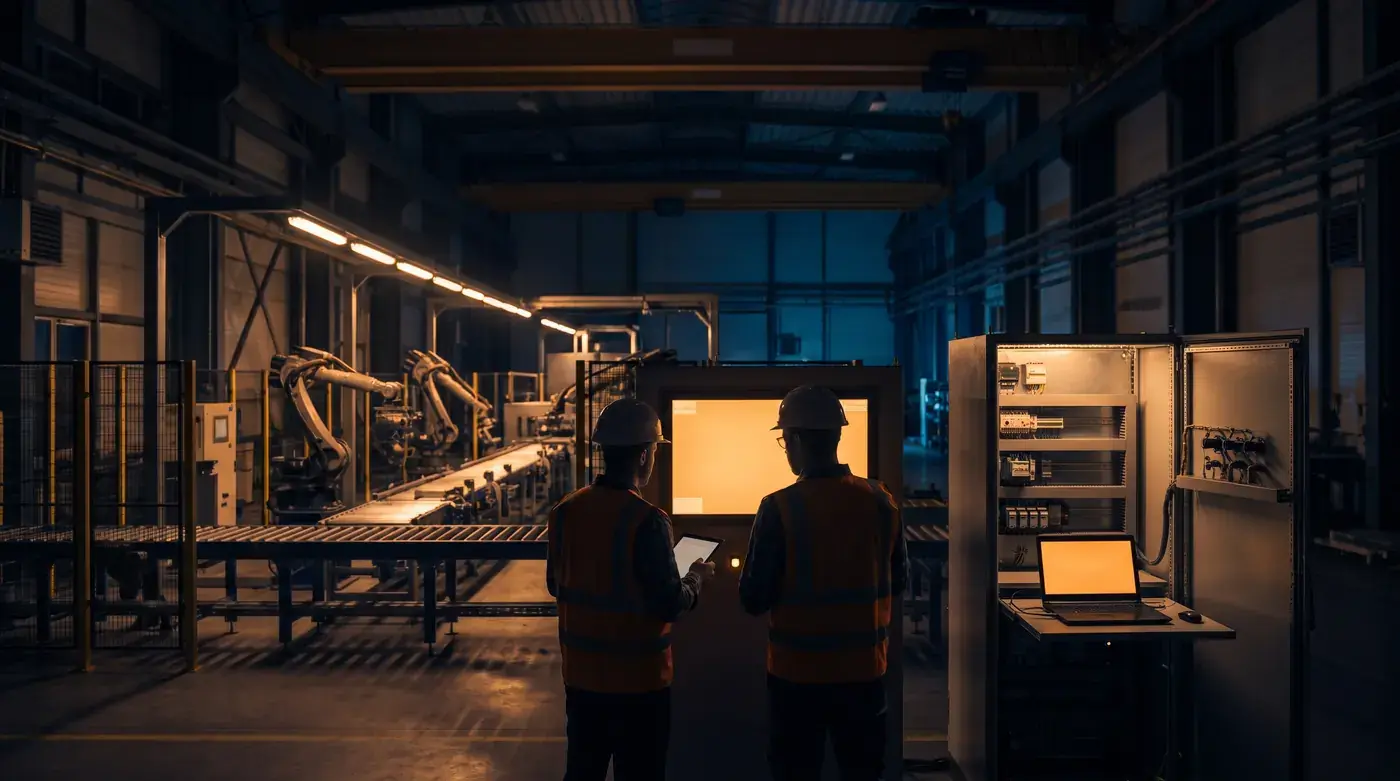
The schedule dies after installation
Mechanical installation is the visible part of an automation project, and it is rarely where the schedule fails. The overrun accumulates afterwards: control logic that behaves differently against real hardware, interlocks nobody simulated, a gripper that works on nine parts in ten, and the long tail of micro-stops that only appear when the line runs a full shift. By then the installation team has moved on, the customer’s production plan has not, and every day of debugging is a day of lost output.
- 40–70%
- less on-site commissioning time reported for virtual commissioning
- 35–40%
- shorter ramp-up on new vehicle production lines using virtual commissioning
- ~30%
- lower commissioning cost in published implementations
What virtual commissioning actually buys
The idea is unglamorous: test the control logic against a simulation model of the machine before the machine exists. Published implementations across welding, assembly and inspection lines report commissioning-time reductions between roughly 41% and 67%; Wipro PARI reported a 70% cut in on-site commissioning time, and BMW around 50% on new production lines. Studies also report up to two-thirds fewer iteration cycles. The gain is not the elegance of the simulation. It is that a control-logic error found in an office costs an afternoon, while the same error found on an installed line costs a shift of production.
Write the acceptance criteria before the quotation
Most commissioning disputes are definition disputes. “The line works” is not a testable claim, and a two-hour witness test is not evidence that it works. The criteria below cost nothing to agree at quotation stage and are close to impossible to negotiate afterwards.
01
Rate, not motion
Parts per hour at defined quality, sustained over a defined period — not one successful cycle in front of visitors.
02
Availability window
Measured across full shifts including changeovers and planned stops, not a quiet two-hour slot.
03
Fault recovery
How the line behaves when something jams, and how long a trained operator needs to clear it unaided.
04
Handover state
Documentation, spare-part list and trained operators are deliverables with dates, not courtesies.
Ramp-up is an organisational problem
Once the line is technically capable, the remaining gap is rarely technical. Operators are still learning the recovery sequences. Maintenance does not yet own the preventive plan. Micro-stops of under a few minutes never reach a log, so nobody can rank them. The plants that ramp fastest treat the curve as a managed project with an owner, a daily number and a Pareto of stoppage causes reviewed every morning — for the first eight weeks, not the first eight days.
If nobody can name the person accountable for the ramp-up curve, the curve will be flat for longer than the plan assumed.
Sources
- Siemens — Wipro PARI case study: 70% reduction in on-site commissioning time
- IET Collaborative Intelligent Manufacturing — Digital twin-based virtual commissioning of a reconfigurable process line (2024)
- Published virtual-commissioning implementations across welding, assembly and inspection lines (41–67% commissioning-time reduction)